 (1),
(1), Prof. Petri P. Kärenlampi
Energy Dissipation Due to Dynamic Straining of Wood
Extended Abstract
Petri P. Kärenlampi, A. Pekka Tynjälä
University of Joensuu, Faculty of Forestry
Box 111, FIN-80101 Joensuu
petri.karenlampi@joensuu.fi
Introduction
Energy dissipation due to dynamic straining of wood is of significance from the viewpoint of fatigue damage, and thus also from the viewpoint of mechanical pulping. We restrict the discussion in damage induced by cycles of uniaxial compressive strain. We intend to find ways of treating the material in a way which would induce mechanical damage, measurable in terms of changes in the physical properties of the material, with a minimum of mechanical energy application.
Wood being an anisotropic composite of polymeric constituents, the loading direction may significantly contribute to the loading result [1, 2, 3]. We intend to examine the effect of loading direction on the energy-efficiency of the creation of mechanical damage. However, designing this kind of experiments is far from trivial. Since material response varies significantly as a function of loading direction, any experimental arrangement should be appropriately scaled according to the directional material properties.
The Material Model
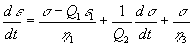
We are using a generalized Voigt material model, where two of the three Voigt elements in series are degenerate. The constitutive equation for uniaxial strain is
(1),
where  and
and  refer to the stiffness moduli of the two elastic elements,
  refers to the uniform
strain within the two parallel elements characterized by
refers to the uniform
strain within the two parallel elements characterized by  and
and  , and
, and  refers to stress within
the element characterized by
refers to stress within
the element characterized by  , which is the same as the stress within the element
characterized by
, which is the same as the stress within the element
characterized by  .
The external stress
equals the sum of the stresses within the elements characterized
by
.
The external stress
equals the sum of the stresses within the elements characterized
by  and
and  .
.
Within this material model, the dissipating
proportion of applied elastic strain energy is a non-monotonic
function of strain rate. The energy dissipation depends on
straining history in a complicated way. However, at a specified
straining history, two dimensionless parameters determine the
dissipating proportion of the applied strain energy. These are  and
and  . We denote the latter
as Applied Dimensionless Strain Rate (
. We denote the latter
as Applied Dimensionless Strain Rate ( ). This dimensionless
strain rate being normalized with directional material properties
and thus making the applied strain rates comparable between
different material directions, it is adopted as our principal
measure of strain rate.
). This dimensionless
strain rate being normalized with directional material properties
and thus making the applied strain rates comparable between
different material directions, it is adopted as our principal
measure of strain rate.
Dimensionless Process Parameters
Let us introduce a cyclical uniaxial strain, determined by
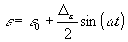 (2),
(2),
where  is strain in the middle of the variation amplitude,
  is strain amplitude and
 is angular
frequency. The change rate of strain is then
is angular
frequency. The change rate of strain is then
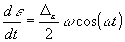 (3).
(3).
We find from Eqs. (9) and (10) that the strain amplitude  and the angular
frequency
and the angular
frequency  have to
be considered. We readily find that
have to
be considered. We readily find that  must exceed 0.5; otherwise the strain
introduced within a cycle could not recover. The dimensionless
inverse amplitude
must exceed 0.5; otherwise the strain
introduced within a cycle could not recover. The dimensionless
inverse amplitude  is taken as the second process parameter.
The remaining experimental variable to be normalized with
material properties is the angular frequency  . Substituting Eqs. (9)
and (10) into (8) shows that
. Substituting Eqs. (9)
and (10) into (8) shows that  reaches its maximum at
  . Then, the maximum of
  becomes
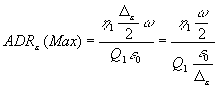 (4).
(4).
The angular frequency solved from Eq. (4) becomes
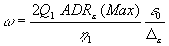 (5).
(5).
In addition to material properties  and
and  , as well as the inverse
normalized amplitude
, as well as the inverse
normalized amplitude  , the angular frequency to be used in the experiment
depends on the selected value of
, the angular frequency to be used in the experiment
depends on the selected value of  .
.
Experimental Results
It is shown that the Applied Dimensionless Strain Rate (), the
prestrain/amplitude ratio and the material dissipation parameter being invariant, the
proportion of applied energy irreversibly dissipating in dynamic
experiments is independent of the applied strain scale  .
.
It is also shown that the Applied Dimensionless Strain Rate
() and the
prestrain/amplitude ratio being invariant, the proportion of applied energy
dissipating is a unique function of the dimensionless dissipation
parameter .
These results imply that the calibrated model reasonably predicts
energy dissipation in different material directions.
References:
1. de Montmorency, W. H.,
The longitudinal grinding of wood - further work. Pulp Paper Can.
49(C3):115-123 (1948).
2. Salmén, L. Tigerström, A. and Fellers, C., Fatigue of
wood-characterization of mechanical defibration. J. Pulp Paper
Sci. 11(3):J68-73 (1985).
3. Hamad, W. D. and Provan, J. W., Microstructural cumulative
material degradation and fatique-failure micromechanisms in
wood-pulp fibers. Cellulose (1995):2, 159-177.